
This Week’s Share
Beets
Carrots
Chard
Cilantro
Garlic
Mizuna
Onions
Mixed Peppers
Potatoes
Winter Squash
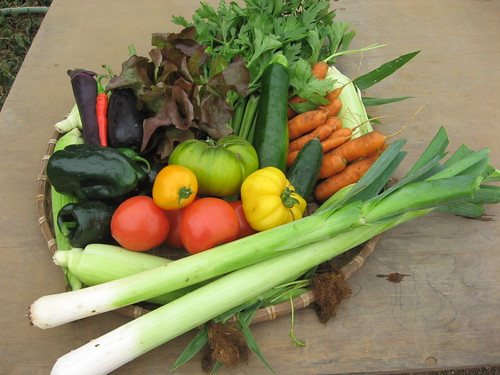
Beets (Kestral) – These rich red roots are rather ripe in Vitamin C, potassium and folic acid! Beet the system and mash them along with potatoes for pink mashed potatoes. I like to grate them raw for a crunchy salad topping.
Fun Fact for kids – If you eat your beets it makes your pee turn pink!
Carrots – Many of you have noticed the pesky brown lines across your carrots and have asked what that is. It is most likely damage caused by the larva of a carrot rust fly, Psila rosae. This small fly literally smells our carrot fields and lays its eggs at the base of the carrots. Upon hatching they happily make their way down to the roots and tunnel away. The carrots were a bit slow to size up early this spring and have been in the ground longer then usual making them more susceptible to this pest. This week we begin harvesting from our later plantings so you should see less damage. Read more about the carrot rust fly.
For the Kids – What do you do when the carrots go on strike? You Picket.
Chard – Don’t pass up the greens! This is the time of year to LOVE them. Wondering how to get your kids and other skeptics to enjoy these nutritionally wonderful leaves? See the recipe that follows.
For the Kids – Botanists have developed a green vegetable that eliminates the need to brush your teeth. Bristle sprouts.
Cilantro – Along with a bevy of medicinal qualities this worldly herb is integral to flavors in Mexican, Indian, Egyptian, and Chinese cooking. Use your ‘ladies handful’ in your cosmopolitan kitchen to season baked fish, chicken soup, or squash curry. Its flavor is lost when over cooked so add it at the end.
For the Kids – The origin of the name for Cilantro comes from Coriander, Koros in Greek which means bedbug…yum bedbugs!
Garlic – This will be the last of the garlic for the season. Unfortunately a portion of our garlic harvest was diseased and therefore did not store well. To combat this issue we bought new garlic seed for next season. A fresh start will hopefully secure a bountiful garlic harvest next season.
For the Kids – “Egyptian slaves built the pyramids on a diet of garlic, bread and water.”
Mizuna – Mizuna is a mild relative to mustard greens and can be eaten raw or slightly wilted. Also delicious stuffed in a sandwich, tossed with fresh pasta, wilted with sautéed mushrooms or stirred into Miso soup.
For the Kids – What does the letter “A” have in common with a flower? They both have bees coming after them.
Onions (Copra) – Don’t let these storage beauties make you cry. Here is a collection of some reasonable to wacky suggestions I have heard to avoid stinging eyes: place in the freezer for 5 minutes before cutting, hold a piece of bread in you mouth while you cut, don’t cut across the root zone (this releases more sulphuric compounds), soak in milk before cutting, cut onion underwater (you or the onion I am not sure)!
For the Kids – What can you make from baked beans and onions? Tear gas.
Peppers – You should have seen it last Friday. Beautiful blue skies, crisp air and Scott, dedicated to every last pepper in the field, tirelessly bringing in load after load of sweet peppers lest the coming frosts beat us to them. With help from Shari and Michael we should have another week of peppers to let the sweetness of summer linger in your stir fry and salads, At farm lunches we have been enjoying them sautéed in plain ‘ol olive oil and salt and put on anything from pasta, potato soup, cheese sandwiches and beans!
For the Kids – Where did the vegetables go to have a few drinks? The Salad Bar.
Potatoes (Sangre) – Americans eat about 125 pounds of potatoes a year making them the most commonly consumed vegetable. It is also my favorite food, in the form of French fries! High in many vitamins and minerals (pssst…leave the skins on) potatoes get a bad rap by the diet industry. It is not the potato itself but how we like to prepare them, fried, cheesy, buttered, that makes the potato a potential heart throb. Go for simple steaming or baking and top with yogurt instead of sour cream.
For the Kids – Why do potatoes make good detectives? Because they keep their eyes peeled.
Winter Squash (Zeppelin) – The squash will keep coming till CSA ends the first week of December. This week is a Delicata variety, so sweet and delicious. You can eat the skins so no troublesome peeling needed. Simply cut into rings, remove the seeds, toss with olive oil and salt, place on a cookie sheet and bake at 350 until tender.
For the Kids – Why did the Squash go out with a prune? Because he couldn’t find a date!
Recipes
Candy is Dandy but Vegetables make you Sweeter!
I admit it…I am the neighbor who hands out apples on Halloween, boxes of raisins, a penny even. But oh no! not Snickers bars and tootsie rolls….those I save for my dark hours hidden in my sock drawer where no one can see me. Even as I write this now, extolling the virtues of chard and beets I am frantically devouring my Newman’s Mint-O’s quickly before my housemates smell the processed junk food on my breath. In my defense I cry out, “But I had Bok choi in my dinner!”
No one is a purist and so it can be a challenge to get those reticent to try a new vegetable to do what we know is good for them. Like, umm, try a new vegetable. A friend and I, after both working with young people to educate them about local agriculture and nutrition started trying recipes in which to ‘hide’ healthy foods in comfortable foods such as Macn’Cheese, mashed potatoes, pizza and soups…Here are a few recipes that we came up.
Healthier MacN’Cheese
1 box elbow macaroni
2 steamed or roasted winter squash (pumpkin works best, but you can use any of the squash you find in your share), seeded, skinned and pureed
2 cloves garlic, diced
one onion, diced
1 cup Plain Yogurt (either full fat or non-fat depending on your preference)
2 tbsp. Olive oil
1 cup grated cheddar cheese plus some to garnish top
1 tsp mustard
1 cup finely chopped chard or other greens
salt and pepper
Preheat oven to 350 º. Cook the macaroni. Lightly cover the bottom of a small pot with oil and sauté diced onion at medium-low until onion is transparent. Add chopped greens and stir till wilted. Remove from heat and allow to cool a bit. Mash in yogurt and squash, add mustard and garlic while mixing the contents at low heat. Stir the noodles with your sauce adding cheese as you do this. Pour into a baking dish and top with extra cheese and bake for 20 minutes or till heated through.
‘Creamy’ Greens
I made this for a recent farm lunch and a co-worker said he liked it so much because it didn’t taste like greens…
1 Bunch greens (one or a mix of chard, collards, kale, mustard…)
1 onion, chopped
2 cloves garlic, roughly chopped
Salt and pepper
2 tbs olive oil
6 oz silken tofu or 8 oz whole milk yogurt
A mix of sweet peppers, chopped
Bring 5 cups of water to boil and add chopped onion and greens. Simmer for about 10-15 minutes. Meanwhile, get your blender/food processor out. Begin gently sautéing red peppers in olive oil with a dash of salt. Let slowly cook while you prepare the rest of the dish. Remove greens from heat and let cool a bit. In batches, puree scoops of kale/onion and liquid with tofu (or yogurt) and raw garlic. Return pureed mixture to pot and stir in red peppers. Season with salt and pepper and serve.
Members Who Receive Boxed Shares
Its time for another blue and purple bin round-up. Please bring back any bins that have lingered in your homes to your next pick-up.
From the Fields
It was a beautiful week with mostly clear skies, cold wind and a warm sun. Clear skies also mean cold nights and we had our first kiss of frost. New winterized boots, shiny new waterproof gear and long underwear are also back in fashion on the farm as our hands and feet adapt to the shifting season.
The flashy summer crops are still sweet in our memory as the corn stands brown, the tomatoes droop black with blight and the unripe melons compost their way back into the soil. The season dictates our dinner as we divert out palates to earthy roots, savory greens, and rich squash. I find myself excited to cook again after all the raw salads and sliced fruits of summer.


 I have had a close eye on the thermometer lately. Rumors of an early winter and a field full of winter squash have kept me on edge. But so far, we have hovered in the mid-forties at night and last week we got all the winter squash tucked safely into big bins under the cover of the pole barn roof. That’s all 7,648 of them. We have also been working on an experimental planting of salad greens in the Haygrove high tunnels. In the past the salad greens we harvest in mid-November to early December have been direct seeded. The direct seeded greens don’t compete as well with weeds at this time of year. They also grow close together when they are direct seeded, which makes for less airflow, leading to more disease and rot. This year we are transplanting all 15 of the Haygrove beds. It’s lots of work up front, but hopefully will pay off in less time weeding and healthier plants. We are still trying to find time for onion and garlic planting – our last big field projects for the season. Once our last planting of the season is done, we will focus primarily on harvesting the crops that are still out in the fields. And as for those rumors of an early winter, many of the crops that are still out in the field; the Brussels sprouts, the collards, the parsnips, the kale and carrots, will all be sweeter as the thermometer drops. So if you are mourning for those last tomatoes, know that the fall bounty is still on its way and has its own sweetness to savor.
 Acorn (Mesa Queen) – As its name suggests, this winter squash is shaped like an acorn. This is a great baking squash, it’s easy to slice into halves and fill with butter. A small acorn squash weighs from 1 to 3 pounds, and has sweet, slightly fibrous flesh. Its distinct ribs run the length of its hard, blackish-green or golden-yellow skin.
 Butternut (Metro PMR) – Beige colored and shaped like a vase. This is a more watery squash and tastes somewhat similar to sweet potatoes. It has a bulbous end and pale, creamy skin, with a choice, fine-textured, deep-orange flesh with a sweet, nutty flavor. It weighs from 2 to 5 pounds. Oh, and the PMR, that stands for powdery mildew resistant plants, just in case you were wondering.
 Delicata (Sugar Loaf and Zeppelin) – Also called Sweet Potato, Peanut squash, and Bohemian squash. This is one of the tastier winter squashes, with creamy pulp that tastes a bit like sweet potatoes. Size may range from 5 to 10 inches in length. The squash can be baked or steamed. The skin is also edible. The delicata squash is actually an heirloom variety, a fairly recent reentry into the culinary world. It was originally introduced by the Peter Henderson Company of New York City in 1894, and was popular through the 1920s. Then it fell into obscurity for about seventy-five years, possibly because of its thinner, more tender skin, which isn’t suited to transportation over thousands of miles and storage over months.
 Hubbard (Baby Blue) – The extra-hard skins make them one of the best keeping winter squashes. These are very large and irregularly shaped, with a skin that is quite “warted” and irregular. They have a blue/gray skin, and taper at the ends. Like all winter squash, they have an inedible skin, large, fully developed seeds that must be scooped out, and a dense flesh.
 Kubocha (Sunshine) – Kabocha is the generic Japanese word for squash, but refers most commonly to a squash of the buttercup type. Kobocha Squash may be cooked whole or split lengthwise (removing seeds). It has a rich sweet flavor, and often dry and flaky when cooked. Use in any dish in which buttercup squash would work.
 Pumpkin (Baby Bear and SnackJack) – We’re growing two varieties this season, New England Pie and Snack Jack. The New England Pie is a standard pie pumpkin, a sweet, and moist. Snack Jack also makes great pies and soups but has the added bonus of hulless seeds. These seeds are the “pepitas” you can buy in the store, delicious toasted or raw as a snack or in salads and sauces.


 Last week we pulled all of our storage onions out of the fields and they are now curing in the barn. In order for onions to store well they need to be harvested in a dry window. It looks like we got them out just in time!


 Galia is a hybrid melon with a lime green flesh that is succulent and very sweet. It has light to medium netting on a highly uniform conical fruit.
 Sugar Nut is a small early canary type of melon with fruits averaging about two pounds. It has greenish white flesh, is sweet and flavorful with a nice smooth texture and a small seed cavity. A 1/2 or whole melon is just the right size for a snack or dessert. It is harvested at the forced slip stage.
 Maverick is an early melon variety, round to slightly oval fruits with a heavily sutured skin. They have an excellent sweet flavor. A kind of American cantaloupe they have orange flesh and a corky “net” on the skin. They are sometimes called muskmelons because of their “musky”, sweet taste.
 Sivan is a charantais type melon. They are a hybrid variety forming a nearly round highly uniform fruit with delicate ribbing and deep orange super sweet flesh.
 New Queen watermelon brings another color of the rainbow to your fruit plates. New Queen matures early and exhibits stunning bright orange flesh that is very tender, crisp and juicy with very few seeds, a 12% sugar content round out this exciting melon.
 It has been a truly amazing experience apprenticing at Sauvie Island Organics. As I enter my final month I want to let you know what a pleasure it has been growing vegetables for you, and how rewarding it has been to get to see first-hand your excitement at pick-up. The next few weeks will become increasingly busy with the harvest in full swing and harvesting my own crops from my 180 ft. by 3 ft. apprentice bed and preparing to relocate. I am leaving the same weekend I graduate the farm for Port Townsend Washington to assist in managing a new 6-acre farm. I look forward to applying all my new found skills and knowledge and thank the farm and you the members for all I have learned in the last 17 months
 The Next Step
