
This Week’s Share:
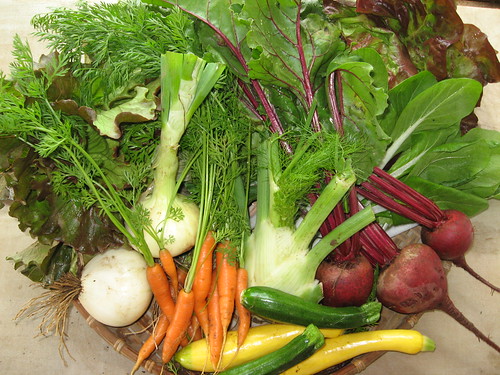
- Beets
- Carrots
- Corn
- Cucumbers
- Eggplant
- Lettuce
- Onions
- Parsley
- Summer Squash
- Tomatoes
*Basil
**Melons
A weekly description of your veggies, with a twist…
Beets – John Evans, from Palmer AK, holds the worlds record for the largest beet ever grown, over 42 pounds! You can see it on the following website. Bet, it didn’t taste as lovely as the beets in your share this week. http://www.recordholders.org/en/records/vegetables2.html
Carrots – Carrots are the 5th most consumed fresh vegetable in the United States. In 2000 Oregon ranked 8th nationally in producing carrots for processing, representing 2.3 % of total U.S. production. http://www.ipmcenters.org/cropprofiles/docs/orcarrots.html
Corn – 80 million acres of land are planted to corn in the US yielding over 650 million pounds, mostly for livestock feed and processed corn products. 4,500 acres were planted in Oregon in 2006. I couldn’t find out how much was sold locally. (USDA)
Cucumbers – “To see cucumbers in a dream denotes that you will speedily fall in love. Or, if you are in love, then you will marry the object of your affection.” Richard Folkard in ‘Plant Lore’ (1884)
Eggplant – From Ode to Eggplant “But your flavor is requited love-The thing that makes all others complete: Garlic, tomato, lentil, lamb, rice. Olive oil would simply be lost without you.” – Persis M. Karim
Lettuce – A “transcontinental” head of lettuce, grown in California and shipped nearly 5,000 kilometers to Washington, DC, requires about 36 times as much fossil fuel energy in transport as it provides in food energy. http://www.worldwatch.org/node/4132
Onions, Walla Walla – “For this is every cook’s opinion, No savory dish without an onion; But lest your kissing should be spoiled, Your onions should be thoroughly boiled.” -Jonathon Swift
Parsley – “Parsley, parsley everywhere. Let me have my victuals bare.” – Ogden Nash
Summer Squash – “You give and give too much, like summer days limp with heat… as we salt and freeze and pickle for the too little to come.” – Marge Piercy’s Attack of the Squash People
Tomatoes – “the tomato offers its gift of fiery color and cool completeness.” -Pablo Neruda
*Basil – “O cruelty, To steal my Basil-pot away from me!” – John Keats
SE Ankeny pick-up will be receiving their half pound this week.
**Melons – In 2004, domestic Cantaloupe production was valued at $300.6 million. Per capita consumption of melons has remained around 25 pounds over the last 15 years. The US is a net importer of Melons, mostly from Mexico. Meanwhile we export over 79% of our crop to Canada and Japan. http://aic.ucdavis.edu/profiles/Melons-2006.pdf Melons, like me, thrive in heat. We get sweeter, our color is better; we are more pleasant to have at the table. So, some shares will begin to see these gems in their share this week.
Seasonal Notes:
Box share picker uppers… Bring Out Your Bins! Bring Out Your Bins! It’s that time of year when we need to issue a recall.
Free Produce at your pick-up site. Just put that cilantro bunch you dislike or the cucumbers you can’t keep up with in the FREE BOX at your pick-up so that others can benefit from your aversions. Don’t just leave your portion in the bins; it makes us think we counted wrong. Thanks!
Ricipes:
Deliciously Simple Bruscetta
For a single gal sometimes it’s all I need for dinner
The Italian equivalent of chips and salsa…
Tomatoes – As many as you like, dice ‘em up
Garlic – Mince up to what your spice factor enjoys
Basil – I would say a ratio of four leaves to every tomato you use
Olive Oil – Good quality is better here, use enough to make your tomatoes wet
Salt and fresh cracked pepper
Dice, mince, chop and stir all the ingredients together. Toast up thin slices of Good Italian Baguette…Eat like chips and salsa
ACHAARI BAINGAN (Eggplant in pickling style)
Cook this dish to impress your friends with Indian culinary skills. Easier then it seems, Kalongi is key but not necessary.
Adapted from Indian Cooking by Madhur Jaffrey (serves 2)
- 1 large eggplant
- 1 tsp ginger-garlic paste
- 1 tsp fennel seeds
- 1/2 tsp nigella seeds (kalonji) (sub cumin if your couldn’t find it)
- 3 medium size tomatoes, finely chopped
- 1 tbsp coriander powder
- a pinch of turmeric powder
- 1 tsp red chili powder (or to your taste)
- salt
- Cilantro for garnish
- oil for frying
Cut eggplant into largish cubes and place them in a bowl of cold water. Pat dry with a towel. Heat 2 tbsp oil in a deep saucepan. When hot, add the eggplant slices and fry them over medium heat until they turn reddish brown. Fry in batches if the saucepan cannot hold all slices at one time. Remove from heat and place on absorbent paper.
Add 1 tablespoon oil to the pan. When hot add fennel seeds and kalonji, as they begin to sizzle and darken add the chopped tomato and ginger-garlic paste. Stir for a minute. Add coriander, turmeric and chili powder. Season with salt.
Mix well and cook for about 2-3 minutes, breaking the tomato pieces with the back of your spoon. Turn the heat up and continue to stir until the sauce thickens
Add the eggplant slices in the sauce and mix gently. Cook for about a minute more. Serve with rice and a cool cucumber salad.
A Midsummer Days Farm
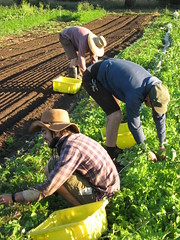
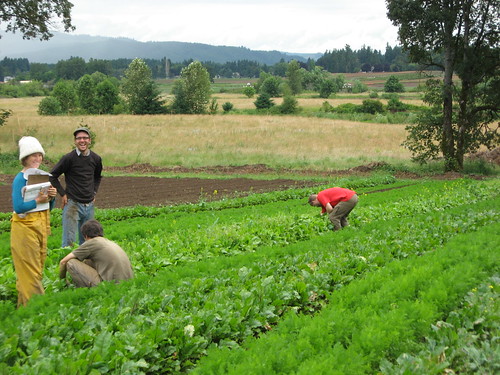
Well into the CSA season the afternoon light begins to yellow in sync with the browning onion tips and golden tassels on the corn tops. Much of the produce coloring your boxes and bags has become more familiar, significant and expected. Likewise the days of work to bring in your vegetables have become more familiar, significant, and expected. With the sun rising later the crew has the welcome shift to a 6:30 start time. That extra half hour of sleep in the morning is sure to feel like a mini-vacation. Our weeding list grows shorter in proportion to the days it seems, as we shift to a harvest heavy day and the last of the lettuce, carrots and fall greens are transplanted and seeded. And do I mean heavy…some beets are almost the size of my head!
Farm life at SIO cultivates lots of time for thought and discussion on topics from the hilarious to the serious. The descriptions for this weeks share were inspired by our field conversations and how they move from the inspirational to tactical to absurd. One moment we are contemplating our totem animals and the end of the next row fretting over what percentage of fresh produce in the global food system is wasted.
It is important to remain inspired as we work hard growing food for our neighbors. I often wonder, feeling perplexed about the tractor trailer of corn I saw pulling out of the farm across the street, where all that corn is going. At the delicious Plate and Pitchfork dinners at the farm last weekend I bit into a hefty Corona bean salad and wondered how much protein and nutrition I was getting compared to a more energy intensive bite of meat. Will I really eat a peck of dirt before I die? What percentage of our income should we be spending on food (down to about 9% from 24% in 1924, Worldwatch Institute) to sustain a healthy food system and fair wages for farmers? These questions, random song lyrics, and lots of numbers run through my head every day that I cultivate beautiful food for you all. It keeps me inspired, along with gratuitous amounts of chocolate, and I hope the vegetables keep you inspired too!
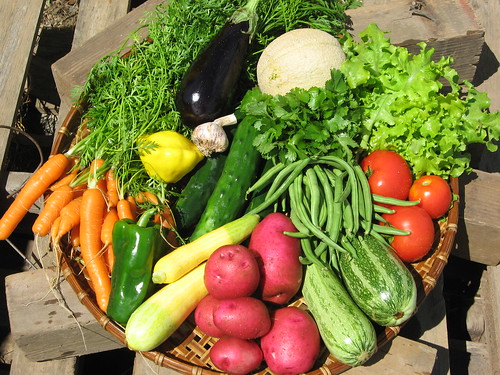
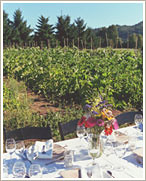 Plate and Pitchfork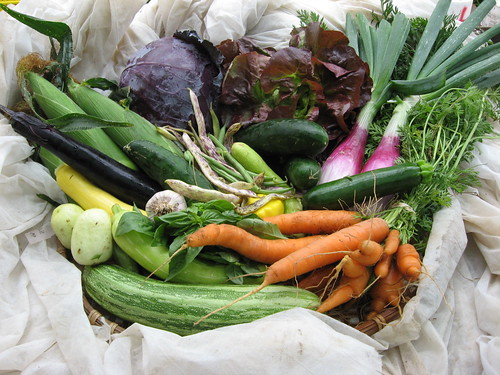
 I’ll write my field notes this time, from the pages of my three ring binder that I lug around with me constantly these days – referring to spreadsheets and recording harvest notes. This notebook holds the map of the season that we chart in the cold winter months, snuggled up to the computer, dreaming and scheming about the season ahead. We imagine the perfect CSA share and then work backwards from there, determining the seeding and planting dates to achieve this harvest. All of this planning is bound together in the multiple excel spreadsheets that fill my farm binder. In the dizziness of summer that is upon us, with pounds and pounds of vegetables flowing into the barn, I take refugee in these notebook pages. They offer me a chance to get my bearings – to figure out where we are between the vision we had back in January and the reality of what the season brings.
 Last Monday we hosted a Farmscaping for Beneficials walk on our farm. These walks are sponsored by OSU and The Xerces Society who are working together on a project to support grower-led activities that build the knowledge and implementation of conservation biological control (CBC) on local farms. Conservation biological control can be defined as methods used on and around farms to restore and enhance beneficial organism populations that can increase to numbers that may limit pest populations. Such methods may include insectary plantings, grassy field margins, beetle banks and hedgerows. We have implemented several of their strategies on our farm to encourage beneficials: whenever possible we allow our cover crop to flower; we grow many cut flowers on the farm, and we have edges that are not disturbed by tillage. We continue to learn what we can do to create habitat that will encourage beneficials and help us to be better farmers.
 This is the second year that Sauvie Island Organics is involved with the Janus Youth Food Works’ program. Food Works is a youth employment program, which engages 14-21 year olds in all aspects of planning and running an entrepreneurial farm business. Their farm is adjacent to ours on Sauvie Island. On Fridays, the one day that we do not harvest and use our barn for pack out, we hear the music of the Food Works youth as they bring their harvest in for washing and packing. You can find them each Saturday at the PSU farmers’ market downtown.
 My name is Kylie and I have been working here at Sauvie Island Organics for a little over a month now. I traveled from a land where yellow brick roads and ruby red slippers can be found on t-shirts in souvenir shops. From Kansas I journeyed west to check out the agricultural scene. I stumbled upon the organic farming scene about a year and a half ago with one semester left before my graduation from the University of Kansas. I was in need of one more credit in order to graduate and decided to take a look at the connection that people have with their food’s roots. I did an apprenticeship on a small farm in Oskaloosa, Kansas and got a taste of, what you all are taking part in, the CSA. I’m in love with this personal form of farming and am excited to meet more of you as the season progresses.
 Our old farm truck has been retired from the road. It is now confined to the fields where it seems most at home. We have recently acquired a little red pick-up from a CSA member that will allow us to run our errands off farm. Thank you Laleña!
 Saturday evening we had a wedding on the farm. Congratulations Amber and Jason! Amber and Jason met as apprentices in 2005 here at Sauvie Island Organics.


 The new set up has also changed the way we seed most of our cover crops. The drop spreader will drop small seed as well as soil amendments so Scott has been seeding with the spreader. He can drag a ring roller behind the tractor which presses the seeds into the soil and this does save a step in seeding cover crop, as well as making it more convenient to do. As a result we have beautiful summer stands of sudan and buckwheat out in the fields right now (The photo below is the most beautiful field of sudan we’ve ever had with vegetables in the background).

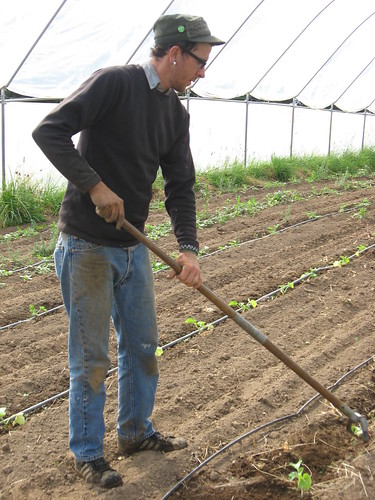 Hello, my name is Brian and I’m a first-year apprentice. Living and working out at the farm is a wonderful way to learn about sustainable farming practices. I’ve really enjoyed watching the season progress thus far and am excited about watching the farm change through the rest of the year. This is going to be my second year working on an organic farm. Last year I worked as an apprentice with Beth Gibans in Joseph, OR. Some of you may remember her from her days working here with Shari at Sauvie Island Organics. I’m really looking forward to the rest of the season and all of the wonderful opportunities that SIO has in store for me. See you Soon. Brian
 Flowers are on their way. Next week we’re expecting to harvest the first cuts of the season. There are still a few flower shares left so if you’d like to sign up there’s still time. Stay tuned next week for more information on how to care for cut flowers.
 Potatoes – Potatoes are traditionally cured after harvest to thicken the skin. This week you are receiving new potatoes. These freshly harvested, uncured potatoes have a thin delicate skin and are particularly flavorful. This week we have three varieties: the red is called Sangre, the blue is All Blue, and the white is Yukon Gold. Note the festive color scheme for the upcoming holiday, and enjoy them in the recipe below.


 can eat them raw, though I highly recommend sautéing or grilling them with a little olive oil and salt and pepper. They make a great addition to just about any meal.
 This week the peppers left the warmth of the green house to be planted out next to the eggplants, both are snug now under their billowing sheets of remay protecting them from the cool nights that are still upon us. The remay came off the summer squash revealing plants doubled in size since they were transplanted two weeks ago and free of cucumber beetles, there are already a few squash flowers and you can anticipate seeing them in your share in just a few weeks. The onion fields are almost all weeded but as the crops grow so does the weeding list, high on priority are the broccoli and potatoes. The last of the tomatoes are being staked and some are soon to be taller than some of us farmers and we are tying and wheel hoeing weekly. Our first corn planting is shin high, right on schedule for knee high by the fourth of July. I know I already mentioned the carrots but carrots are almost here, so are the beets!